Key takeaways from our latest webinar

What Constitutes Healthy?

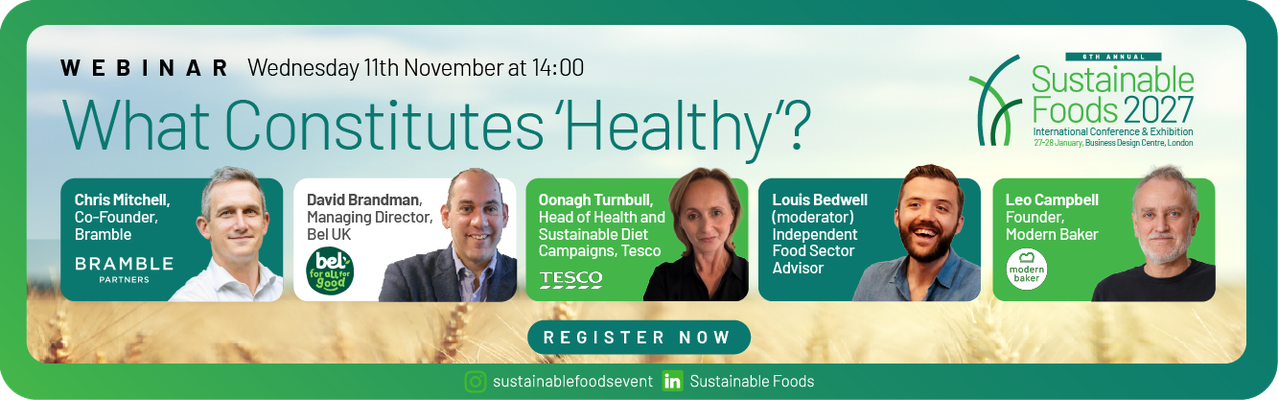
Ask a room full of food industry leaders what makes food healthy and you get a lot of different answers, and a lot of firmly held views. That was the point of our webinar on 11 November, which followed on from the Sustainable Foods whitepaper What Constitutes Healthy?

It was good timing. That same morning, UCL had published research showing how differently UK dietary guidance, food labelling and regulation can judge much the same products. As moderator Louis Bedwell put it, for businesses this is not a theoretical debate. It shapes how products are developed, marketed and sold.

Louis started with the World Health Organization's definition of health: a state of complete physical, mental and social wellbeing, not merely the absence of disease. That is a much broader idea than a nutrient score on a pack. The panel spent the hour working out what it means in practice:


Key Takeaways:

  • Healthy Is a Diet, Not a Product: Judge food by the role it plays in the whole diet, counting the nutrients it adds as well as its fat, salt and sugar.
  • Add Goodness, Don’t Just Take Out the Bad: Cutting things out hasn’t worked. Adding fibre, polyphenols and other good ingredients can make everyday foods actively healthy.
  • Joyful Nourishment Wins: People only eat better if they enjoy it, so healthy food has to taste good, be affordable and be easy to choose.
  • The Definition of Healthy Is Leaving the Industry’s Hands: GLP-1 drugs, AI shopping assistants and home testing are giving consumers more control. Brands that adapt will win.


Watch the full webinar here:

Six themes to define the discussion

One of the session's most consistent refrains was the danger of over-engineering the data question. Having 80% visibility into your supply chain is sufficient to identify hotspots, prioritise action and begin engaging suppliers meaningfully. Build your data systems now — ahead of regulatory deadlines — and accept that the first iteration won't be flawless. Transparency and a consistent methodology matter more than precision.

Oonagh Turnbull said health is not a hard sell at Tesco. More than three-quarters of its customers say they are interested in health and want help eating better. What gets in their way is affordability and convenience. Health is also personal. Tesco sees at least eight different health missions among its shoppers at any one time, from children's health to caring for elderly parents.

On whether the industry needs one common standard, Oonagh said yes, because otherwise no one can compare like with like. Investors and campaigners need consistent reporting. But she warned against getting stuck arguing over which metric to use when the real job is to change food.

David Brandman called the Nutrient Profiling Model (NPM) a compass for the industry, not a final verdict. Healthy should not be defined only by what is taken out, such as salt, fat and sugar. It should also count the nutrients people need more of.

His example was cheese. It contains fat, but also protein, calcium, iodine and vitamin D. Nearly a quarter of UK adults are low in vitamin D, and one in two teenage girls don't get enough iodine. "Food is more than just its worst nutrient," he said.

Fruit puree is another point of contention. GoGo squeeZ pouches contain free sugars, but these come from the fruit itself, not added sugar. Bel's research suggests the pouch's glycaemic impact is close to an apple's and well below apple juice or biscuits. David called for an arbitration process alongside the NPM to deal with exceptions like this. The uncertainty has real effects: Bel has paused a planned GoGo squeeZ fruit launch because it expects the product to fail the 2018 NPM model, which would make shelf space and advertising harder to win.

Leo Campbell argued that the current system has the wrong starting point. It judges food by the chemical make-up of its ingredients, using assumptions made in labs decades ago, rather than by what the food actually does in the body. Today we can measure blood sugar response, how fats reach the bloodstream and what happens in the gut microbiome. Modern Baker does this with a toolkit at Newcastle University.

He said decades of taking things out of food to make it healthier have not worked. His alternative is what he calls "Health Plus": adding diverse fibres, polyphenols and other bioactive compounds, the good things in fruit and veg, to the foods people already eat. Processed food is not going away, he said, so the opportunity is to make everyday food actively good for us. His bread, Superloaf, is the proof of concept.

Chris pointed to the Food Compass as one model that already rewards what is good in food. It scores 54 characteristics across nine areas, including processing and fibre, and is linked in trials to better cardiometabolic outcomes. He contrasted this with NutriScore, Health Star Rating and the UK NPM, which he described as mainly penalty-based

Oonagh said the HFSS rules were a turning point. The rules were about where products could be placed in store, but their biggest effect was that suppliers reformulated so their products could stay in prime spots. Many of those new versions have since become the norm. Tesco set its own healthy sales target at the same time. "What gets measured in retail definitely gets managed," she said, but policy is not a magic wand.

She added that reformulation can only go so far. What is really needed is new products that are simply good, whatever measure is used. Fresh food is currently Tesco's strongest growth area, month after month.

Leo said challenger brands have an advantage here, because they can have bolder conversations about health than big brands can risk. When Superloaf launched in Waitrose, 17% of its shoppers were new to the bread aisle. He believes larger companies should partner with challengers to get breakthroughs to market.

Looking ahead, Chris said shoppers are becoming more informed and empowered. Bramble's work with Nielsen found almost 12% of UK households now include someone taking a GLP-1 weight loss drug. People on these drugs are more likely to ask AI tools what to eat, or to order tests for nutrient deficiencies. As AI shopping assistants arrive, they will read the back of the pack, not the marketing on the front. Companies that adapt will win, he said, and those that don't face a slow decline.

Leo summed it up: for the first time, the definition of healthy is being taken away from the food industry.

The question of cost was left open. David said even the healthiest product does nothing for public health if it stays on the shelf because it is too expensive, not tasty enough or not understood. Leo pointed out that the cost of diet-related disease to the UK is roughly twice the size of the entire UK grocery market.

One line each: what should the industry do next?

To finish, Louis asked each panellist for a single line:

  • Leo Campbell: The industry needs to come together, as a kind of future Food and Drink Federation.
  • Oonagh Turnbull: "Let's focus on the things we agree on and move forward with them."
  • Chris Mitchell: "Fill the fibre gap."
  • David Brandman: Act as an industry collective, with manufacturers, retailers, government, nutritionists and NGOs tackling it together.

The panel disagreed on how healthy should be defined, but agreed on the direction. Count what food adds as well as what it takes away. Make healthier food enjoyable, affordable and easy to choose. And keep moving rather than waiting for the rules to settle.